The Long Shadow of the Crab
A look through history reveals how humanity's understanding of cancer has evolved from ancient Egyptian medical papyri to modern gene editing and personalized immunotherapy.
By James Morris · Sept/Oct 2026
“"For a long time, understanding cancer was like trying to solve a murder mystery without a magnifying glass. "”
From ancient mummies to gene-editing superheroes, humanity’s been waging a battle against cancer that feels older than time itself.
Let’s face it—just hearing the word “cancer” is enough to make most people’s stomachs do a backflip. It’s scary, no doubt about it. But here’s the thing: cancer isn’t some modern-day bogeyman that popped up because of processed foods or binge-watching Netflix (though, let’s all remember to take a walk every now and then).
This sneaky illness has been around for ages. Seriously, we’re talking prehistoric times. Scientists have even found evidence of cancer in dinosaur bones that are a whopping 70 to 80 million years old. That’s right—T-Rexes might have been the kings of the Cretaceous, but even they weren’t immune to this ancient foe.
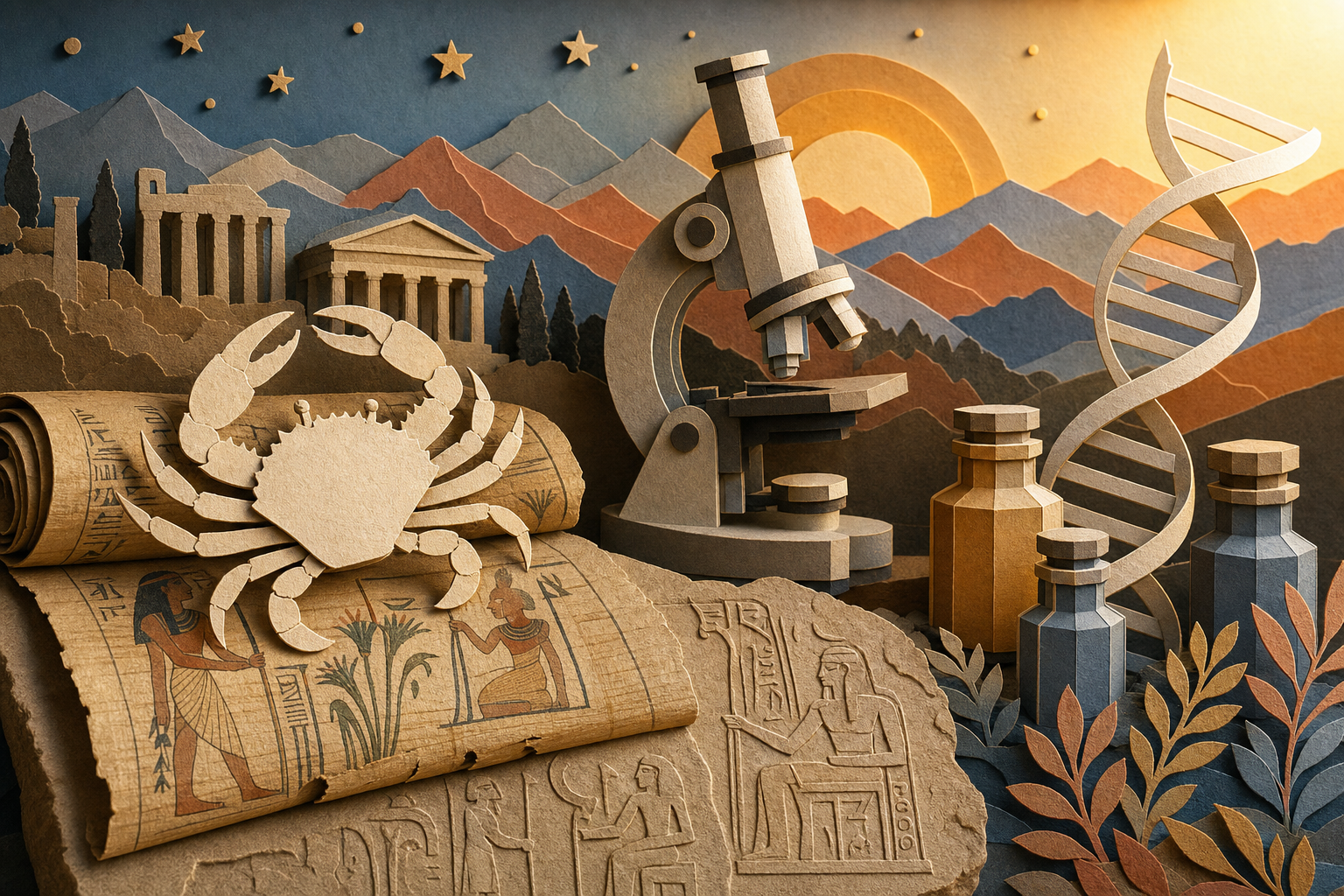
And when it comes to humans, the earliest evidence of cancer dates back to ancient Egypt. Fossilized bones and mummies from around 3000 BCE show tumors, with the Edwin Smith Papyrus describing a “bulging tumor of the breast.” Guess ancient Egyptians had their hands full with more than just pyramid-building.
Why is it Called "Cancer"?
Now, here’s a fun fact to drop at your next trivia night: the word “cancer” comes from the Greek word for crab (carcinos). Why a crab, you ask? Well, Hippocrates, the father of medicine back in 460–370 BCE, thought tumors resembled a crab’s legs because of their finger-like projections. (Personally, I think that’s a bit of a stretch—maybe Hippocrates was just hungry?)
Later, a Roman doc named Celsus stuck with the crab theme and gave us the Latin word cancer. And voilà, the name stuck.
Fast forward a few centuries, and the theories about cancer were... let’s just say, “creative.” Some thought it was caused by an excess of black bile (a charming ancient Greek idea), while others were convinced it was a punishment from the gods. Spoiler alert: it’s neither of those things.
The Dawn of Modern Science: Cancer Gets Personal
For a long time, understanding cancer was like trying to solve a murder mystery without a magnifying glass. Then, in the 1600s, along came the microscope—a game-changer if there ever was one. Suddenly, scientists could see cells, and by the 19th century, Rudolf Virchow figured out that cancer cells come from normal cells gone rogue. You could say Virchow was the Sherlock Holmes of cellular science.
But wait, it gets better. In the 1700s, two incredibly observant dudes started piecing together how lifestyle and environment play a role in cancer. Italian doctor Bernardino Ramazzini noticed nuns had high rates of breast cancer but rarely cervical cancer (and concluded it had something to do with celibacy). Meanwhile, British surgeon Percival Pott realized chimney sweeps were getting scrotal cancer from soot exposure. Yes, chimney sweeps—Disney forgot to mention that in Mary Poppins.
When Genes Became the Star of the Show
The real plot twist came in the mid-20th century with the discovery of DNA’s structure. Scientists finally cracked the code: mutations in genes were driving cancer. Some of these mutations were inherited (thanks, family tree), while others were caused by environmental factors like smoking or UV rays.
By the 1970s, researchers had identified oncogenes (genes that promote cancer growth) and tumor suppressor genes (the healthy guys trying to keep everything in check). Think of it as a cellular tug-of-war, but in cancer, the bad guys cheat and win.
And then came the Human Genome Project in 2000, which was like unlocking the cheat codes for human biology. Suddenly, scientists could identify tons of gene mutations linked to cancer, paving the way for personalized medicine. Today, treatments can be tailored to the specific genetic quirks of a patient’s tumor. It’s like your cancer gets its own personalized playlist of treatments—except instead of songs, it’s lifesaving therapies.
The Evolution of Cancer Treatments: From Knives to Nanotech
Back in the day, treating cancer was basically just surgery. If you had a tumor, they’d cut it out and hope for the best. Then came radiation therapy, followed by chemotherapy—both of which saved lives but often came with brutal side effects. (Let’s just say chemo isn’t exactly a spa day.)
But modern medicine doesn’t mess around. Immunotherapy, for example, is like giving your immune system a pep talk and sending it into battle against cancer. Drugs like pembrolizumab—approved in 2014 for advanced melanoma—basically take the brakes off your immune cells, letting them go full Hulk on cancer.
Then there’s CAR T-cell therapy, where scientists reprogram your own T-cells to hunt down cancer cells like a heat-seeking missile. It’s like a sci-fi movie, but real.
And let’s not forget targeted therapies like trastuzumab, which zero in on specific cancer-causing genes. In 2017, pembrolizumab even got a “tumor-agnostic” approval, meaning it could treat tumors with certain genetic changes anywhere in the body. Talk about shaking things up!
The Future is Bright (and Busy)
The fight against cancer is far from over, but we’ve come a long way since the days of crabs and black bile. Clinical trials like NCI-MATCH and Pediatric MATCH are testing therapies based on the genetic makeup of tumors rather than where they show up in the body. Researchers are even tackling the infamous KRAS gene, a notorious troublemaker in pancreatic and colorectal cancers, with new drugs like sotorasib.
And it’s not just about curing cancer—it’s also about improving quality of life for patients. New treatments for cancer cachexia (a wasting syndrome) are giving people more energy to keep fighting. As Nick Prochak wisely said, “Cancer is a part of our life, but it’s not our whole life.” Or as Aaliyah Parker put it, “There’s almost always something to smile about,” even on the toughest days.
So, while the shadow of the crab is still looming, each new discovery chips away at it. From ancient Egyptians scratching their heads over tumors to scientists reprogramming immune cells in cutting-edge labs, humanity’s determination is nothing short of inspiring. One day, cancer might just be a thing of the past. And when that day comes, maybe we’ll finally let the T-Rex rest in peace.
Prefer the printed page? Flip through the Sept/Oct 2026 issue — this story starts on page 16.
Keep reading

Wellness · Well-Being Series
Gentle Routines That Restore Mind, Body, and Spirit
Simple, daily self-care habits can boost mental clarity, physical health, and emotional well-being, helping older adults flourish at every stage of life.
James Morris · page 15
Wellness · Well-Being Series
The Science of Social Health
Scientific research shows that strong social connections enhance longevity, boost immunity, and protect mental sharpness, proving that meaningful relationships are vital medicine for seniors.
James Morris · page 12
Creativity
Learning Something New to Stay Connected and Engaged
Taking up new hobbies, exploring digital tools, and joining group classes keeps brain health strong while fostering community and personal growth.
James Morris · page 26